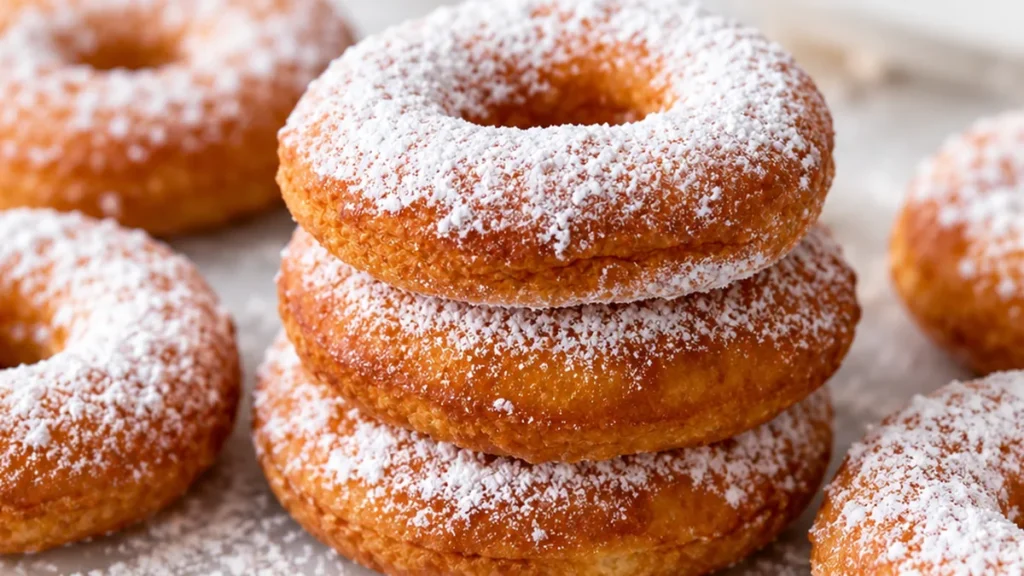
These irresistible gluten free mochi donuts are easy to make at home. Using simple ingredients, you can enjoy a chewy and satisfying treat.
Key takeaways
- Use glutinous rice flour for the best chewy texture.
- Monitor oil temperature to prevent greasy donuts.
- Let shaped donuts rest before frying for better handling.
- Experiment with ingredient swaps for varied flavors and textures.
Irresistible Gluten-Free Mochi Donuts That You Must Try!
Ingredients
Instructions
- In a large bowl whisk egg, milk, melted butter, and vanilla until smooth.
- In a separate bowl, whisk together glutinous rice flour, sugar, baking powder, and salt.
- Pour wet ingredients into dry ingredients and mix until a soft dough forms. It should be smooth and pliable, not overly sticky.
- Lightly flour a surface with a bit of glutinous rice flour. Roll the dough out to about 1/2-inch thickness.
- Cut out donut shapes using a round cutter and a smaller cutter for the center. Re-roll scraps as needed.
- Heat 2-inch-deep oil in a pot to 350°F (175°C). Fry donuts in batches for 2–3 minutes per side until golden and puffed. Remove and drain on paper towels.
- Sprinkle with powdered sugar if desired and serve warm or at room temperature.
Understanding the Role of Glutinous Rice Flour
Gluten-free mochi donuts rely heavily on glutinous rice flour, which provides the chewy texture characteristic of mochi. Unlike regular wheat flour, glutinous rice flour contains a higher percentage of amylopectin, which contributes to its sticky and elastic properties. This unique starch structure requires careful hydration; typically, a ratio of 1:1 water to flour by weight is ideal to achieve the perfect dough consistency.
Common Pitfalls and How to Avoid Them
One frequent issue when making mochi donuts is the dough becoming too sticky or too dry. If the dough is too sticky, it may be due to excess moisture; reducing the water by 10-15% can help. Conversely, if the dough is too dry, adding small amounts of water gradually until the desired consistency is reached will rectify the issue. Another common problem is uneven cooking; ensure your oil temperature is around 180°C (350°F) for optimal frying. If the temperature is too low, the donuts will absorb more oil and become greasy.
Ingredient Swaps and Their Effects
While the traditional recipe calls for glutinous rice flour, you can experiment with sweet rice flour or even a blend of gluten-free all-purpose flour for different textures. Sweet rice flour will yield a slightly sweeter and denser donut, while all-purpose flour may give a lighter texture but will lose some of the chewy characteristics. Additionally, for a dairy-free version, substitute milk with almond or coconut milk, which will impart a subtle flavor without compromising consistency.
Key Factors for Perfectly Shaped Donuts
The shape of your mochi donuts is crucial for both aesthetics and cooking. Using a donut cutter ensures uniformity in size, which promotes even cooking. If you lack a donut cutter, you can create a makeshift one using two round cookie cutters of different sizes. Additionally, let the shaped donuts rest for about 10 minutes before frying; this resting period allows the dough to firm up slightly, making them easier to handle and fry.
Unique Characteristics of Mochi Donuts
What sets mochi donuts apart from traditional donuts is their unique texture and chewiness. The use of glutinous rice flour not only alters the texture but also gives the donuts a distinctive flavor profile that is subtly sweet and nutty. This chewy texture is a hallmark of mochi, making these donuts a delightful departure from conventional fried treats.
How to Properly Store Your Donuts for Freshness
Storing mochi donuts requires careful consideration to maintain their unique texture and flavor. These donuts are best enjoyed fresh, but if you need to store them, place them in an airtight container at room temperature for up to two days. For longer storage, consider freezing them. Wrap each donut individually in plastic wrap and then place them in a freezer-safe bag. They can be frozen for up to three months. To enjoy, simply thaw them at room temperature or reheat them in a microwave for a few seconds to restore their softness.
Scaling Your Recipe for Different Occasions
Scaling the recipe for mochi donuts is straightforward, making it easy to accommodate gatherings or special events. If you want to double or triple the recipe, ensure that you maintain the same ratios of ingredients. However, be mindful of your mixing and frying equipment; larger batches may require more space for frying, which can affect cooking times. Always monitor the temperature of the oil to ensure even cooking, as larger quantities may lower the oil temperature more significantly.
Choosing the Right Equipment for Perfect Donuts
The equipment you use can significantly impact the outcome of your mochi donuts. A deep fryer is ideal for maintaining a consistent temperature, which is crucial for achieving that perfect golden-brown exterior. If using a stovetop, a heavy-bottomed pot can help stabilize the heat. Additionally, using a thermometer to monitor the oil temperature (around 175°C to 180°C) will ensure that the donuts cook evenly without absorbing excess oil. A donut cutter or piping bag can also help shape the donuts uniformly, contributing to their aesthetic appeal.
Flavor Pairings That Enhance Your Donuts
While mochi donuts are delicious on their own, pairing them with complementary flavors can elevate the experience. Consider serving them with a dipping sauce like matcha glaze or chocolate ganache for added richness. Fresh fruits like strawberries or raspberries can provide a refreshing contrast to the denser texture of the donuts. Additionally, pairing them with a warm cup of green tea or a creamy latte can enhance the overall flavor profile, making for a delightful treat any time of the day.
Understanding the Texture: Why Mochi Donuts are Chewy
The unique texture of mochi donuts comes from the glutinous rice flour used in the recipe. This flour contains a higher starch content compared to regular wheat flour, which contributes to the chewy consistency that defines mochi. When cooked, the starches gelatinize, creating a dense yet tender structure. For optimal results, ensure that the dough is not overmixed, as this can lead to a tougher texture. Additionally, cooking at the right temperature—around 180°C (356°F)—is crucial to achieving that perfect golden exterior while maintaining a chewy interior.
How to Scale Your Mochi Donut Recipe Effectively
Scaling your mochi donut recipe can be straightforward, but attention to detail is necessary. When doubling or tripling the recipe, be mindful of the ratios of wet to dry ingredients. Maintaining the same ratio ensures the texture and flavor remain consistent. It’s also essential to consider the cooking time; larger batches may require slight adjustments in frying time. Monitor the color and texture of the donuts closely to prevent overcooking. For larger gatherings or events, preparing the dough ahead of time and refrigerating it can streamline the process without compromising quality.
Serving Suggestions to Enhance Your Mochi Donuts
While mochi donuts are delightful on their own, pairing them with complementary flavors can elevate the experience. Consider serving them with a side of matcha or chocolate dipping sauce to enhance the overall taste. Fresh fruits like strawberries or citrus can add a refreshing contrast to the chewy texture. Additionally, dusting the donuts with powdered sugar or a light glaze can provide an appealing visual and flavor contrast. For seasonal variations, infuse the dough with spices like cinnamon or nutmeg during the fall, or use citrus zest in the summer for a bright flavor.
Understanding the Optimal Temperature for Frying Mochi Donuts
The temperature at which you fry your mochi donuts plays a crucial role in achieving that perfect golden-brown exterior while maintaining a chewy interior. Ideally, the frying oil should be heated to around 180°C to 190°C (350°F to 375°F). If the oil is too hot, the outside may brown too quickly, leaving the inside undercooked. Conversely, if the oil is not hot enough, the donuts will absorb excess oil, resulting in a greasy texture. To ensure consistent frying, use a thermometer to monitor the oil temperature. Frying in small batches can also help maintain the oil temperature, allowing for even cooking.
Making Ahead: Preparing Mochi Donuts for Future Enjoyment
Mochi donuts can be made ahead of time, allowing for convenience without sacrificing quality. Prepare the dough and shape the donuts, then freeze them on a baking sheet until solid. Once frozen, transfer them to an airtight container or freezer bag for up to one month. When ready to enjoy, fry them straight from the freezer, adding a minute or two to the frying time. This method preserves the unique texture of the donuts while allowing for spontaneous enjoyment. However, it’s best to glaze or coat them after frying to prevent sogginess during storage.
Understanding the Best Techniques for Frying Mochi Donuts
Frying mochi donuts requires precise temperature control to achieve that perfect golden-brown exterior while maintaining a chewy interior. The ideal frying temperature is around 180°C (350°F). If the oil is too hot, the donuts may brown too quickly, resulting in an undercooked center. Conversely, if the oil is not hot enough, the donuts will absorb too much oil, becoming greasy. Use a thermometer to monitor the oil temperature closely. Additionally, frying in small batches allows for better temperature maintenance and ensures even cooking. Aim for a frying time of about 3-4 minutes per side, flipping them halfway through for uniform browning. This technique not only enhances the texture but also improves the overall flavor of the donuts.
How to Scale Your Mochi Donut Recipe for Different Occasions
Scaling your mochi donut recipe can be straightforward, but it requires careful adjustments to maintain the desired texture and flavor. For larger batches, consider the hydration levels and the mixing time. Doubling or tripling the recipe may require more thorough mixing to ensure the ingredients are well incorporated. When increasing the batch size, it’s essential to keep the ratio of glutinous rice flour to liquid consistent. If you’re preparing for a gathering, it’s advisable to fry in smaller batches to maintain oil temperature and ensure quality. For special occasions, experimenting with flavors or fillings can also be a great way to enhance the appeal of your mochi donuts without complicating the scaling process.
Pro tips
Pro tip: Best served immediately while hot!
Frequently asked questions
Can I make these donuts without glutinous rice flour?
While glutinous rice flour is essential for the chewy texture, you can experiment with sweet rice flour or a gluten-free all-purpose flour blend. However, the texture may vary significantly from traditional mochi donuts.
How do I know when the donuts are cooked through?
The donuts should be golden brown on the outside. You can also test one by cutting it in half; it should be cooked through and not doughy in the center. Frying them at the correct temperature helps ensure even cooking.
What is the best way to store leftover mochi donuts?
Store leftover mochi donuts in an airtight container at room temperature for up to two days. For longer storage, consider freezing them. Reheat in the microwave for a few seconds to restore some of their original texture.
Can I add flavors or fillings to these donuts?
Absolutely! You can incorporate flavors such as matcha or cocoa powder into the dough. For fillings, consider using sweet red bean paste or chocolate ganache, adding them before shaping the donuts for a delightful surprise.
More from Gluten-Free Bread & Baking →