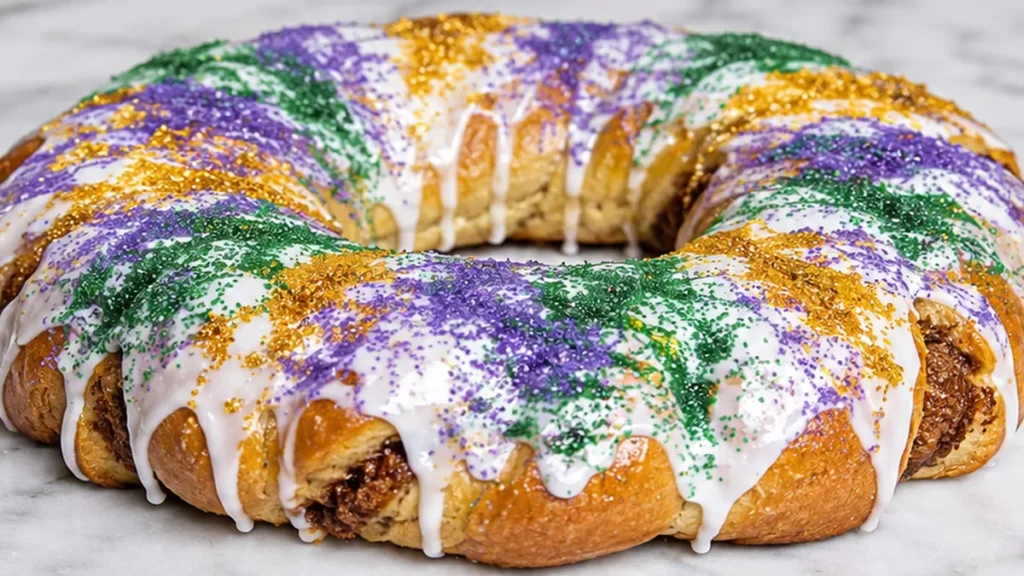
The secret to an exceptional gluten-free king cake lies in achieving a light, airy dough that rivals its traditional counterpart. This recipe focuses on a specific blend of gluten-free bread flour and xanthan gum to ensure a tender crumb and excellent structure, which can often be a challenge in gluten-free baking. Crafting a delicious gluten-free king cake is about more than just ingredients; it’s about technique. Gluten-free king cake dough can turn out too dense and fail to rise properly. Adjusting the liquid content and kneading time, as detailed in this recipe, made all the difference, transforming it into a truly magnificent centerpiece for any celebration.
Key takeaways
- Using gluten-free bread flour ensures a better structure.
- Xanthan gum is essential for mimicking gluten’s elasticity.
- Proper hydration and rising time are crucial for texture and flavor.
- Sealing the dough well prevents leaks during baking.
Gluten-Free King Cake: Celebrate!
Ingredients
- 3 tsp instant yeast
- 1 tbsp sugar
- ⅔ cup warm milk
- 3 ½ cups gluten-free bread flour
- 2 tsp xanthan gum
- 3 tbsp sugar
- 2 tsp baking powder
- 2 large eggs
- ¼ cup unsalted butter
- ¼ tsp salt
- ½ cup brown sugar
- 1 tbsp cinnamon powder
- 2 tbsp gluten-free all-purpose flour
- 2 tbsp unsalted butter
- 1 tsp vanilla extract
- ½ cup chopped apple
Instructions
- Prepare the dough: In a mixing bowl, combine instant yeast, 1 tbsp sugar, and warm milk. Mix well, cover with a kitchen towel, and let it rest for 10-15 minutes until bubbly. Set aside.
- In a standing mixer bowl, mix gluten-free bread flour, xanthan gum, the remaining 3 tbsp sugar, and baking powder. Whisk all dry ingredients until fully incorporated.
- Add the large eggs and pour in the yeast mixture. Attach the hook to the standing mixer and mix for 10-15 minutes. Add more milk if the dough appears too dry.
- Once the dough is smooth, add the unsalted butter and salt. Mix again until the dough is uniformly smooth.
- Transfer the dough to a floured flat surface. Knead for 5 minutes, then form it into a ball. Place the dough in an oiled clean bowl, cover with a damp kitchen towel, and let it rest for 40-45 minutes, or until it has doubled in size.
- Prepare the cinnamon filling: Combine brown sugar, cinnamon powder, gluten-free all-purpose flour, unsalted butter, vanilla extract, and chopped apple. This mixture can be refrigerated until ready to use.
- When the dough is ready, transfer it to a flat surface covered with parchment paper. Place another sheet of parchment paper over the dough and roll it into a ¼-inch thick rectangle. Position the longer side closest to you for easier rolling.
- Spread the cinnamon sugar mixture evenly over the dough, leaving a 1-inch clean border. Using the parchment paper, roll the dough into a log, then securely pinch the seam and ends closed.
Video
Notes
The technique that makes it
The success of a gluten-free king cake largely hinges on the balance of moisture and structure provided by the ingredients. The use of gluten-free bread flour is crucial as it contains more protein than regular gluten-free flour, which helps mimic the elasticity typically provided by gluten. The addition of xanthan gum is essential for binding and gives the cake a chewy texture. Proper hydration is also key; the warm milk activates the yeast and helps the dough rise, while the eggs contribute to richness and moisture. When mixing, ensure that the dough is not overworked, as this can lead to a dense cake. Allowing the dough to rise in a warm environment promotes the development of flavor and texture.
Troubleshooting
- Issue: Cake is too dense.
Fix: Ensure you are using gluten-free bread flour and include xanthan gum to improve texture. - Issue: Cake doesn’t rise.
Fix: Check that your yeast is fresh and that the milk is warm but not hot, as high temperatures can kill the yeast. - Issue: Cake is dry.
Fix: Increase the amount of liquid slightly or add more eggs to retain moisture. - Issue: Filling leaks out.
Fix: Make sure to seal the edges of the dough well before baking to prevent the filling from escaping.
Substitutions
- Gluten-free bread flour: Use a gluten-free all-purpose flour blend, but check if it contains xanthan gum; if not, add it separately.
- Unsalted butter: Substitute with coconut oil or vegan butter for a dairy-free option.
- Chopped apple: Use chopped pears or berries for a different flavor profile while maintaining moisture.
- Brown sugar: Swap with coconut sugar for a lower glycemic index alternative that still adds sweetness.
Pro tips
- For optimal rise, ensure your warm milk is between 105-115°F (40-46°C) to properly activate the instant yeast. Too hot will kill it, too cold won’t activate it.
- Do not over-knead the gluten-free dough; unlike wheat flour, excessive kneading can make it tough. Mix just until smooth and combined.
- Storage: Leftover king cake can be stored at room temperature, tightly wrapped, for up to 3 days. For longer freshness, freeze individual slices for up to 2 months and thaw at room temperature.
This gluten-free king cake offers all the festive joy and deliciousness of the classic, without compromise. Experiment with different fillings or decorative icings to make it your own. Enjoy this delightful treat!
Frequently asked questions
Can I use regular flour instead of gluten-free flour?
No, this recipe is specifically designed for gluten-free flour. Regular flour contains gluten, which is not suitable for gluten-free diets.
What can I use instead of eggs?
You can use flaxseed meal or chia seeds mixed with water as an egg substitute. Use 1 tablespoon of flaxseed meal or chia seeds mixed with 2.5 tablespoons of water for each egg.
How do I store leftover king cake?
Store leftover king cake in an airtight container at room temperature for up to 3 days. For longer storage, wrap it tightly and freeze for up to 3 months.
Can I make the dough ahead of time?
Yes, you can prepare the dough in advance. After mixing, let it rise, then refrigerate it for up to 24 hours before shaping and baking. Allow it to come to room temperature before baking.
More from Gluten-Free Bread & Baking →