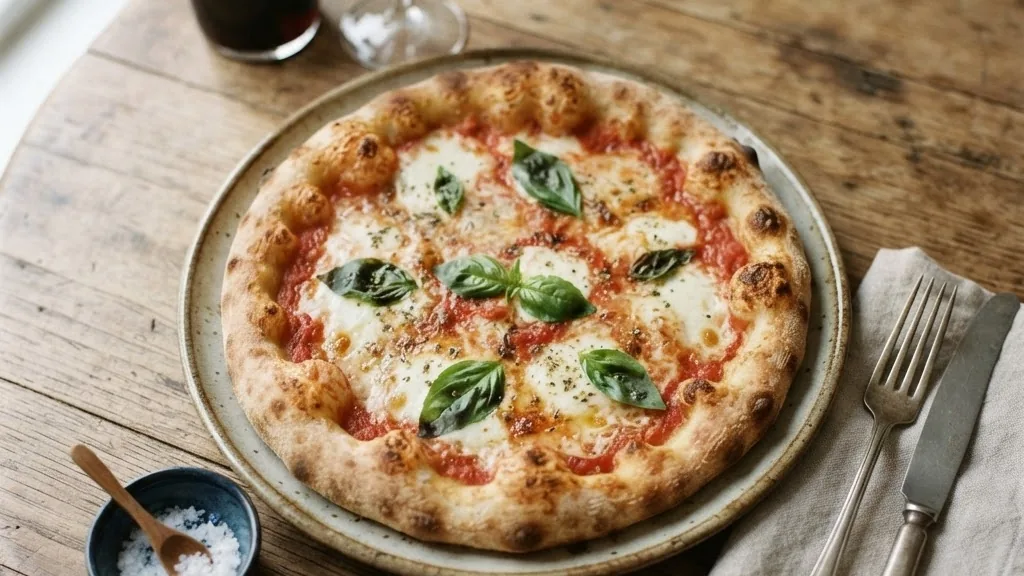
Gluten free pizza gluten free is really one question wearing two coats: how do you make a crust at home that holds up like wheat, and how do you keep it safe if someone at your table has celiac disease. Most recipe pages answer the first and skip the second. This guide handles both, with weight-based measuring, the binder decision that separates chewy from crumbly, and a shared-kitchen protocol drawn from the U.S. Food and Drug Administration labeling rule and third-party certifiers. The exact focus phrase describes a stuffed search string that Google reads as a single recipe intent, so the work here is depth, not repetition.
You will get gram targets, oven temperatures, freezer windows, a flour comparison that does not lock you into one brand, and a style-by-style breakdown so you can pick thin, thick, or cracker crust on purpose instead of by accident. Bring a scale.
Quick answer: To make gluten free pizza that behaves like wheat, weigh a 1:1 blend such as King Arthur Measure for Measure or Bob’s Red Mill 1-to-1, add a binder (xanthan gum for structure or about 20 g psyllium husk powder for chew), and work with a wetter, batter-like dough. Bake on a hot stone around 13 minutes, longer than the roughly 8 minutes an equivalent wheat pizza needs. For celiac guests, use a dedicated stone, fresh parchment, and new jars to stay under the FDA gluten-free ceiling of less than 20 parts per million.
What “gluten-free” legally means before you bake anything
Gluten-free is a legal claim in the United States, not a vibe. The U.S. Food and Drug Administration sets the rule under 21 CFR 101.91, effective since August 2014, and defines a gluten-free label as containing less than 20 parts per million of gluten. That threshold equals 20 milligrams of gluten per 1 kilogram of food. A tighter standard exists: the Gluten-Free Certification Organization, a program run by the Gluten Intolerance Group, requires less than 10 parts per million, half the FDA ceiling. King Arthur’s gluten-free ’00’ pizza flour carries that GFCO certification. Both numbers matter because your home kitchen is not a lab, and knowing the target tells you how careful the handling has to be.
- FDA gluten-free: less than 20 ppm, the labeling floor for any product using the words on a package.
- GFCO certified: less than 10 ppm, verified by third-party audit.
- Home kitchen: no certification exists. Your job is to protect the ingredients, not to prove a number.
The 20 ppm figure is not just a U.S. quirk. Codex Alimentarius, the joint FAO/WHO food standards body, set the international reference point that most gluten-free rules trace back to, and the European Union’s Regulation 828/2014 mirrors the same 20 ppm line for foods sold as gluten-free. So whether the flour bag in your pantry was milled in Vermont or imported, the number on the label is answering to roughly the same standard worldwide.
The detection science backs these limits. The standard sandwich assay, ELISA method AOAC 2012.01, reliably reads down to roughly 2 to 5 ppm, comfortably below both the FDA and GFCO thresholds. That headroom is why a well-labeled, well-verified flour is trustworthy even without a home lab. For patient-facing label guidance, the Celiac Disease Foundation and Beyond Celiac both publish plain-language explainers worth reading before your first bake, and the National Celiac Association tracks how well the labeling system actually performs in practice.
Celiac cross-contamination: the shared-kitchen protocol incumbents skip
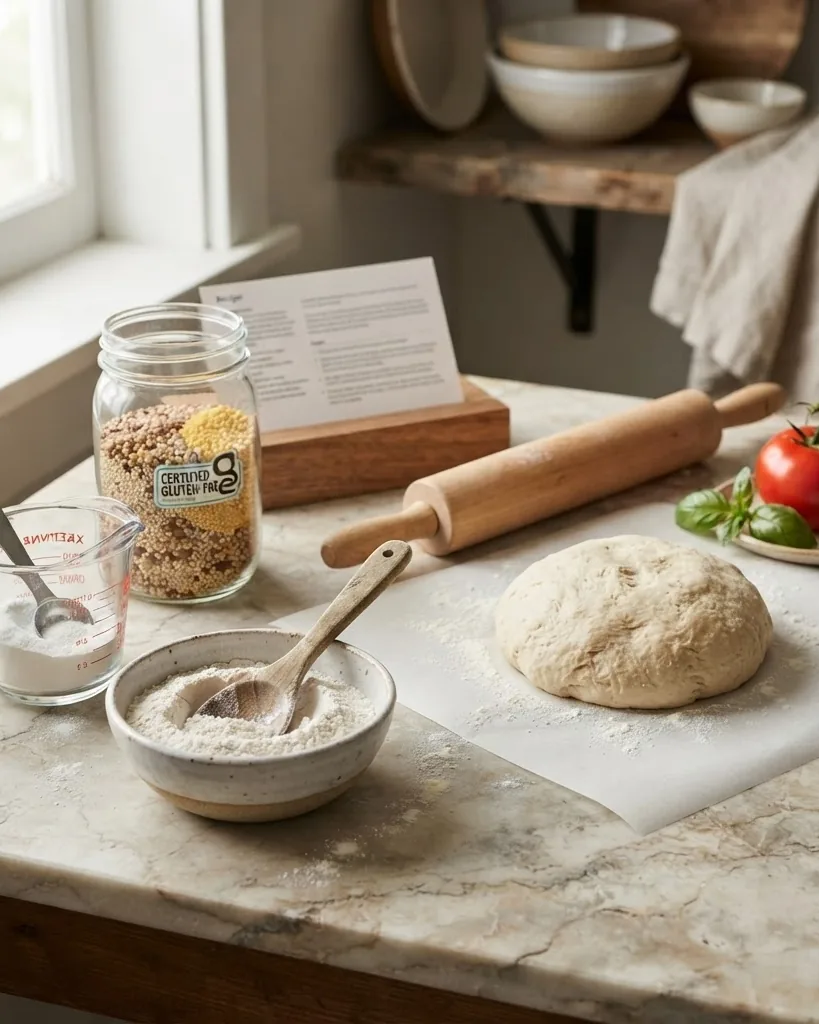
Cross-contamination is where most gluten-free pizza fails a celiac guest, even when every ingredient is compliant. Celiac disease affects about 1 in 100 people, roughly 1 percent of Western populations, and for them a dusting of wheat flour from a shared peel is enough to trigger damage. The threshold you are defending is the FDA line of less than 20 parts per million, which is only 20 milligrams of gluten per kilogram of food. That is a smear, not a handful. So the protocol is physical separation, not just clean ingredients.
Build a dedicated set of tools and never let them touch wheat:
- Baking surface: a stone or steel used only for gluten-free bakes, since porous stone traps flour that a wash will not fully remove.
- Parchment: a fresh sheet under every pie, so the crust never meets a shared surface.
- Jars and scoops: new sauce and topping jars, because a spoon that touched a wheat crust and went back in contaminates the whole jar.
- Oven and utensils: wipe the oven, use clean cutters and a clean peel, and bake gluten-free first if you are baking both.
The scale of the risk is measurable, and the news is mostly reassuring for labeled products specifically. A product-testing study of 275 gluten-free-labeled foods found only 1.1 percent exceeded 20 ppm, meaning 98.9 percent were compliant. Among foods not labeled gluten-free but with no gluten ingredients listed, 19.4 percent exceeded 20 ppm and 10.2 percent exceeded 100 ppm, per the National Celiac Association. A separate Italian surveillance program covering 4,615 gluten-free-labeled samples between 2019 and 2022 found 97 percent measured below 5 ppm and 99.4 percent were fully compliant with gluten-free labeling rules, a result reported in the peer-reviewed record at PMC9834871.
The lesson from both data sets is blunt: labeled ingredients are trustworthy at a population level, unlabeled ones are a gamble, and your handling decides the rest. The National Celiac Association and Gluten Free Watchdog, the independent testing outfit run by Tricia Thompson, MS, RD, both track this reality closely and publish updates as new products hit shelves.
Flour options head-to-head: single-bag vs proprietary vs DIY
Flour choice sets the texture ceiling before you add water. There is no single best gluten-free pizza flour, only trade-offs, and the biggest mistake is treating any 1:1 blend as identical to another. A flour-agnostic master approach beats brand lock-in: one method, three flour paths, predictable results. America’s Test Kitchen has noted the practical split in its own testing, King Arthur blends tend to bake denser and less chewy, while Bob’s Red Mill runs thicker and airier with a faint bean note from the chickpea content. Weigh everything, because a cup of one blend and a cup of another can differ by dozens of grams, and volume measuring is the single most common reason a home gluten-free dough turns out too dry or too wet.
| Flour path | Texture | Best for |
|---|---|---|
| King Arthur Measure for Measure | Denser, less chewy | Crisp thin crust |
| Bob’s Red Mill 1-to-1 | Thicker, airier, slight bean flavor | Pan and chewy styles |
| King Arthur GF ’00’ (proprietary) | Toothsome, Neapolitan-capable | High-heat thin pies |
| DIY blend | Fully tunable, more effort | Experienced bakers |
Why does the proprietary flour behave differently? King Arthur’s gluten-free ’00’ composition tells the story: gluten-free wheat starch, corn starch, sorghum flour, cellulose and psyllium fiber, inactive yeast, and xanthan gum. The cellulose builds fiber and structure, and the psyllium hydrates fast for what the maker calls a toothsome chew. That fiber engineering is exactly what a plain 1:1 bag lacks, which is why the binder you add yourself matters so much on the generic path.
A DIY blend gives the most control but demands the most attention, since you are balancing starches, proteins, and gums yourself rather than trusting a pre-mixed ratio. Bakers who go this route typically combine a base starch (rice or corn), a protein-carrying flour (sorghum or millet), and a small starch for tenderness (tapioca or potato starch), then dial in xanthan or psyllium separately. If baking with almond-based blends interests you, the technique carries over from projects like these chewy almond flour cookies, where hydration and binder balance decide the whole result.
Xanthan gum vs psyllium husk: the binder decision that makes or breaks chew
The binder is the single most important choice in gluten-free pizza dough, because there is no gluten network to trap gas and give stretch. Two binders dominate, and they do different jobs. Xanthan gum binds: it holds the crumb together and stops the dough from falling apart, which is why nearly every 1:1 blend already contains some. Psyllium husk does something xanthan cannot, it builds chew and stretch, giving a crust closer to real wheat. Many bakers who want a pull-apart, foldable slice reach for psyllium specifically.
The swap has a known ratio. To replace xanthan gum in a standard dough, use about 20 grams of psyllium husk powder, and dissolve it into the recipe’s water first so it forms a gel before it meets the flour. That gelling step is not optional; add dry psyllium to dry flour and you get grit instead of stretch. Whole husk and powder are not interchangeable by weight, so match the form your recipe names, since whole husk absorbs water more slowly and unevenly than the finely ground powder.
- Xanthan gum: binding and crumb integrity, small amounts, already in most blends.
- Psyllium husk powder: chew and stretch, about 20 g to replace xanthan, gel in water first.
Expect a wetter, almost batter-like dough either way. Gluten-free pizza is high-hydration by nature, and slack dough spread with wet fingers or under parchment is normal, not a mistake. If it feels too loose to shape by hand, that is the dough telling you to press it into a rimmed sheet or a hot pan rather than toss it in the air. Fighting the dough toward wheat-style handling is the fastest way to tear it and lose the gas it needs to rise.
Styles compared: Neapolitan, thick pan, and cracker-thin
Not every gluten-free pizza should chase the same texture, and picking a style before you mix the dough saves a lot of frustration. A high-hydration, low-starch custom blend can get remarkably close to a real wheat Neapolitan pie, with a soft, slightly charred edge, and typically yields two 11-inch pies from one batch. This style rewards a very hot oven and a short bake, so it pairs naturally with the high-temp equipment discussed below.
Thick pan styles go the opposite direction, leaning into the batter-like nature of gluten-free dough instead of fighting it. A pan crust is pressed rather than stretched, baked longer at a lower heat, and comes out chewy and substantial, closer to a Sicilian or deep-dish slice. This is often the easiest entry point for a first-time gluten-free baker because there is no shaping skill required, just a well-oiled pan and patience.
Cracker-thin crust sits at the other extreme: a lower-hydration dough rolled or pressed very thin, baked hot and fast until crisp all the way through. It carries less of the gummy-center risk that plagues thicker gluten-free crusts, simply because there is less interior mass to fully set. If you are still troubleshooting texture, starting with a cracker-thin bake is a good diagnostic, since it removes the timing margin for error almost entirely.
Equipment that changes the outcome
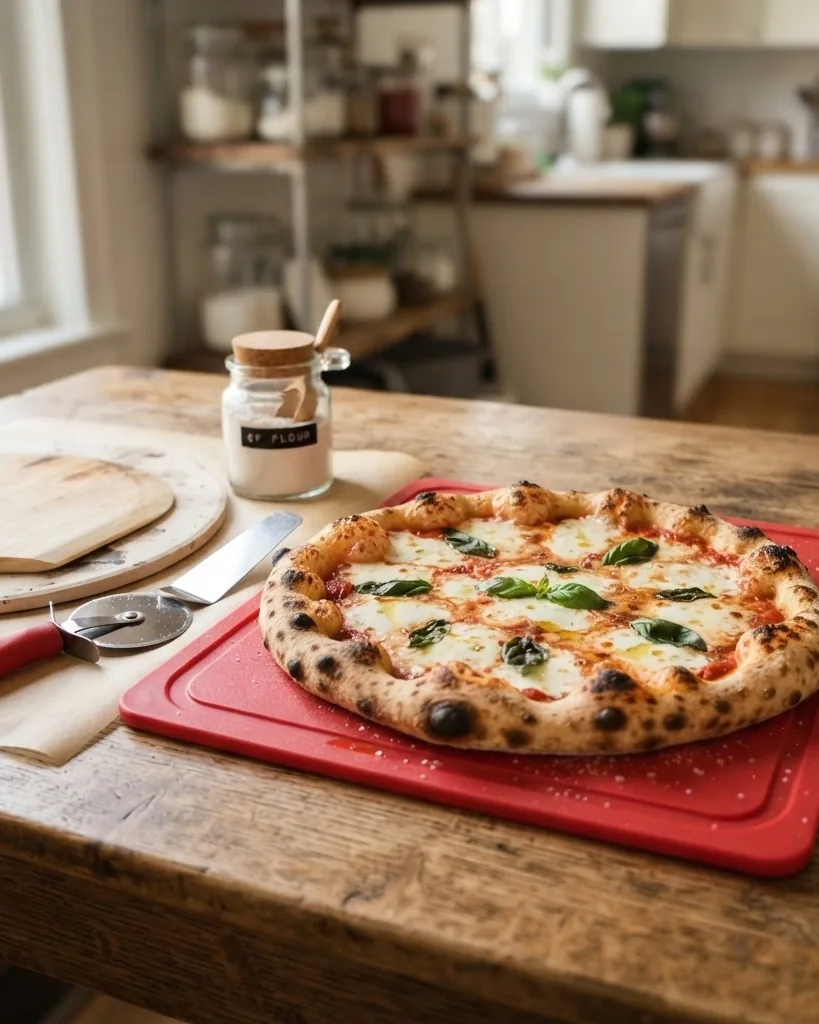
Gluten-free dough is unforgiving of underpowered equipment in a way wheat dough is not, mostly because there is no gluten elasticity to compensate for uneven heat or a weak mix. A baking stone or steel preheated fully before the pizza goes in is close to non-negotiable for thin and Neapolitan styles, since a cold or lukewarm surface stalls the crust before it sets and locks in a gummy middle. A sheet pan is the forgiving fallback for pan-style and slack, wet doughs, since it needs no launching skill and tolerates a batter-like consistency.
A stand mixer earns its keep here too. Because gluten-free dough behaves more like a thick batter than a kneadable wheat dough, hand-mixing it fully is tiring and often incomplete, leaving pockets of dry flour or unhydrated gum. A paddle attachment on a stand mixer distributes the binder evenly, which matters more than kneading time ever would. Finally, a digital kitchen scale is the one piece of equipment every gluten-free baker should treat as mandatory rather than optional, since the difference between a workable dough and a brick is often a matter of grams, not intuition.
Bake method and temperature: why gluten-free needs longer in the oven
Gluten-free pizza bakes longer than wheat, and skipping that time is the main cause of a gummy center. On a hot home stone, a gluten-free pie needs about 13 minutes, compared with roughly 8 minutes for an equivalent wheat pizza, according to Breadtopia’s testing. The extra minutes drive off the higher moisture in the starch-heavy dough and let the interior set. Pull it at wheat timing and the middle stays wet and dense while the edge looks done.
Your equipment sets the strategy:
- Home oven with stone or steel: preheat fully, bake around 13 minutes, consider a par-bake for wetter doughs so the crust firms before toppings go on.
- Sheet pan: reliable for slack dough and thick pan styles, no launching skill needed.
- High-temp oven (Ooni or Gozney): a Neapolitan-style bake runs at about 400 Celsius, which is 750 Fahrenheit at the stone, for roughly 2 to 3 minutes, per Gozney.
Par-baking is the quiet trick for gluten-free. Bake the naked crust until it is set and lightly colored, then add sauce and toppings and finish the bake. This prevents the soggy handoff between a wet dough and a wet sauce, and it is the same logic that makes a reheated slice work. The crust-by-crust air fryer reheat method uses the same idea in reverse, driving moisture out fast to restore snap without scorching the edge. For high-heat cooking technique more broadly, the food-truck world has refined fast-hot workflows worth borrowing, catalogued across the mobile food trucks archive.
Make-ahead, freezing, and the troubleshooting fixes you actually need
Make-ahead is where a home gluten-free pizza habit becomes sustainable, and the freezer is your best tool. You have two paths: freeze the raw dough, or freeze a par-baked crust, and each stores well for up to about 3 months. Par-baked crust is the more forgiving option because the structure is already set, so it thaws and finishes without the shaping struggle of cold, slack raw dough. Wrap tightly, label with the date, and thaw in the refrigerator before the final bake.
Most failures trace to two problems, and both have direct fixes:
- Gummy center: underbaked or too wet. Bake longer toward that 13-minute stone target, par-bake the crust first, and reduce sauce load.
- Crumbly or dry crust: not enough binder or too much flour from scooping instead of weighing. Weigh the flour, check your xanthan or psyllium, and add water toward a slacker dough.
- Dough tears when shaping: it is meant to be batter-like; press under parchment with wet fingers instead of stretching.
- Won’t brown: stone not hot enough or oven opened too often; preheat fully and leave it shut.
Toppings carry hidden gluten too. Check soy sauce, some processed meats, and anything with malt, since these routinely fail a gluten-free assumption even when the pizza base is clean. Keep a running list of safe staples; the primer on gluten free foods that belong on your plate is a solid starting point. When you want dessert to close the night, a peppermint brownie ice cream cake keeps the whole meal in the same safe lane. For high-protein topping ideas that hold on a crust, the high-protein recipes collection is a useful raid.
Nutrition and label reading: gluten-free is not automatically healthier
Gluten-free describes the absence of a protein, not a nutrition upgrade. Many gluten-free crusts lean on refined starches like rice flour, tapioca starch, and potato starch to replace the structure wheat used to provide, and those starches can put the carbohydrate count of a gluten-free crust in the same range as a wheat crust, sometimes higher depending on the blend. A cauliflower-based crust is a genuinely different product with a different nutrition profile, not a like-for-like swap, and treating it as interchangeable with a starch-based gluten-free dough will misread both the texture and the macros.
Reading labels carefully still matters even after you trust the 20 ppm system. The Celiac Disease Foundation and Beyond Celiac both recommend checking for the actual gluten-free claim and certification mark rather than assuming a product is safe because it looks plant-based or simple. Fiber content is another number worth watching, since psyllium and cellulose additions in blends like King Arthur’s GF ’00’ flour meaningfully raise fiber compared to a plain starch blend, which affects both texture and how the crust digests.
Frequently asked questions
Is homemade gluten-free pizza safe for celiac disease?
It can be, but only with cross-contamination control. Use gluten-free-labeled ingredients, a dedicated stone, fresh parchment, and new jars, because the FDA gluten-free line is less than 20 parts per million, or 20 milligrams per kilogram. A trace of wheat flour from shared tools can cross that limit for someone with celiac disease, even when every ingredient is compliant.
Why does my gluten-free pizza have a gummy center?
Almost always underbaking. Gluten-free dough holds more moisture and needs about 13 minutes on a hot stone versus roughly 8 minutes for wheat. Bake longer, par-bake the naked crust before adding toppings, and go easy on the sauce. Weighing flour instead of scooping also prevents an overly wet dough that never sets in the middle.
Xanthan gum or psyllium husk for pizza dough?
Use both jobs in mind. Xanthan gum binds the crumb and is already in most 1:1 blends. Psyllium husk builds chew and stretch closer to wheat. To replace xanthan, use about 20 grams of psyllium husk powder and gel it in the recipe’s water first so it hydrates before meeting the flour.
Can I freeze gluten-free pizza dough or crust?
Yes, and up to about 3 months for either. Freezing a par-baked crust is more forgiving than raw dough because the structure is already set, so it thaws and finishes without the slack-dough shaping struggle. Wrap tightly, label the date, and thaw in the refrigerator before the final bake for the cleanest texture.
Does gluten-free mean healthier or lower carb?
No. Gluten-free describes the absence of gluten, not the nutrition profile. Many gluten-free crusts are starch-heavy and comparable in carbohydrates to wheat, sometimes higher. A cauliflower base is a genuinely different product rather than a direct swap. Read labels the way the Celiac Disease Foundation and Beyond Celiac recommend, and judge each recipe on its own numbers.
Which flour blend should a beginner use?
Start with a single-bag 1:1 blend rather than a DIY mix, since it removes one variable while you learn hydration and binder handling. King Arthur Measure for Measure gives a denser, less chewy result better suited to thin crust, while Bob’s Red Mill 1-to-1 runs thicker and airier with a mild bean note and suits pan styles. Weigh either one rather than measuring by volume.